Friday, 13 December 2019
Tuesday, 29 October 2019
The 23 -rd USE's Informatics task casual support on VK Informatics_100 on the go (UPDATE 1)
https://vk.com/informatics_100?z=photo-40390768_457277148%2Fwall-40390768_199869

Fork two 08.2016 charts
Notice that ¬X1=>¬X2≡X2=>X1 and ¬X3=>¬X4≡X4=>X3
Thursday, 24 October 2019
Style 08.2016 on the go (Solving systems of Boolen Equations for USE Informatics)
Original system
(x1=>y1)^(x1 v x2)^¬(x1^x2)=1
(x2=>y2)^(x2 v x3)^¬(x2^x3)=1
(x3=>y3)^(x3 v x4)^¬(x3^x4)=1
(x4=>y4)^(x4 v x5)^¬(x4^x5)=1
(x5=>y5)^(x5 v x6)^¬(x5^x6)=1
(x6=>y6)^(x6 v x7)^¬(x6^x7)=1
(x7=>y7)=1
Notice first ( due to De Morgan rules ) :-
(x1 v x2)^¬(x1^x2)=(x1 v x2)^(¬x1 v ¬x2)=
=x1^¬x2 v x2^¬x1 = x1⊕x2
Convert to equivalent
(x1=>y1)^(x1⊕x2)=1
(x2=>y2)^(x2⊕x3)=1
(x3=>y3)^(x3⊕x4)=1
(x4=>y4)^(x4⊕x5)=1
(x5=>y5)^(x5⊕x6)=1
(x6=>y6)^(x6⊕x7)=1
(x7=>y7)=1
Fork 08.2016 chart to solve the system
(x1=>y1)^(x1 v x2)^¬(x1^x2)=1
(x2=>y2)^(x2 v x3)^¬(x2^x3)=1
(x3=>y3)^(x3 v x4)^¬(x3^x4)=1
(x4=>y4)^(x4 v x5)^¬(x4^x5)=1
(x5=>y5)^(x5 v x6)^¬(x5^x6)=1
(x6=>y6)^(x6 v x7)^¬(x6^x7)=1
(x7=>y7)=1
Notice first ( due to De Morgan rules ) :-
(x1 v x2)^¬(x1^x2)=(x1 v x2)^(¬x1 v ¬x2)=
=x1^¬x2 v x2^¬x1 = x1⊕x2
Convert to equivalent
(x1=>y1)^(x1⊕x2)=1
(x2=>y2)^(x2⊕x3)=1
(x3=>y3)^(x3⊕x4)=1
(x4=>y4)^(x4⊕x5)=1
(x5=>y5)^(x5⊕x6)=1
(x6=>y6)^(x6⊕x7)=1
(x7=>y7)=1
Fork 08.2016 chart to solve the system
Monday, 21 October 2019
Solution of one USE Informatics system of Boolean equations in 08.2016 style
Original system
Orinal system
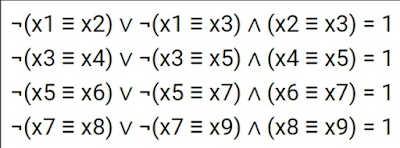
¬(x1≡x2)v¬(x1≡x3)^(x2≡x3)=1
¬(x3≡x4)v¬(x3≡x5)^(x4≡x5)=1
¬(x5≡x6)v¬(x5≡x7)^(x6≡x7)=1
¬(x7≡x8)v¬(x7≡x9)^(x8≡x9)=1
Convert to equivalent
(x1≡x2) => (x1⊕x3)^(x2≡x3) =1
(x3≡x4) => (x3⊕x5)^(x4≡x5) =1
(x5≡x6) => (x5⊕x7)^(x6≡x7) =1
(x7≡x8) => (x7⊕x9)^(x8≡x9) =1
Here we have transition variables x3,x5,x7 rather then transition pairs
between equations. Thus we would manage via 08.2016 charts.
Consider a bit more complex sample of similar system
((x1≡x2)≡x3)=>(x1⊕x4)^((x2≡x3)≡x4)=1
((x4≡x5)≡x6)=>(x4⊕x7)^((x5≡x6)≡x7)=1
((x7≡x8)≡x9)=>(x7⊕x10)^((x8≡x9)≡x10)=1
Transition variables are x4 and x7. Fork 08.2016 chart for this system
Orinal system
¬(x1≡x2)v¬(x1≡x3)^(x2≡x3)=1
¬(x3≡x4)v¬(x3≡x5)^(x4≡x5)=1
¬(x5≡x6)v¬(x5≡x7)^(x6≡x7)=1
¬(x7≡x8)v¬(x7≡x9)^(x8≡x9)=1
Convert to equivalent
(x1≡x2) => (x1⊕x3)^(x2≡x3) =1
(x3≡x4) => (x3⊕x5)^(x4≡x5) =1
(x5≡x6) => (x5⊕x7)^(x6≡x7) =1
(x7≡x8) => (x7⊕x9)^(x8≡x9) =1
Here we have transition variables x3,x5,x7 rather then transition pairs
between equations. Thus we would manage via 08.2016 charts.
Consider a bit more complex sample of similar system
((x1≡x2)≡x3)=>(x1⊕x4)^((x2≡x3)≡x4)=1
((x4≡x5)≡x6)=>(x4⊕x7)^((x5≡x6)≡x7)=1
((x7≡x8)≡x9)=>(x7⊕x10)^((x8≡x9)≡x10)=1
Transition variables are x4 and x7. Fork 08.2016 chart for this system
The solution of one well-known problem from the USE Informatics forum in the format 08.2016 (Russian Federation)
Original wording in Helen Mironchikc's group
https://vk.com/club180658320?w=wall-180658320_64%2Fall
The first pass looks for the total number of solutions of the system, the second pass considers the number of false decisions. Answer: 448 - 32 = 416
https://vk.com/club180658320?w=wall-180658320_64%2Fall
The first pass looks for the total number of solutions of the system, the second pass considers the number of false decisions. Answer: 448 - 32 = 416
Saturday, 19 October 2019
Разбор СтатГрад 23.09.2019 Информатика ЕГЭ №23 vs решение в стиле 08.2016 той же задачи 23
Оригинальное решение
https://www.youtube.com/watch?time_continue=4&v=_Hf22YG3uU0
Разобрали по СтатГраду ответ 81 ( титанические усилия завершаются с ошибкой - "1" по строке "01" должна быть удалена так как y8=>x8=1 )
Решение в стиле 08.2016 ( с правильным ответом при этом еще и предоставляет foolproof by default )
(x1=>x2)^(y2=>y1)=1
(x2=>x3)^(y3=>y2)=1
(x3=>x4)^(y4=>y3)=1
(x4=>x5)^(y5=>y4)=1
(x5=>x6)^(y6=>y5)=1
(x6=>x7)^(y7=>y6)=1
(x7=>x8)^(y8=>y7)=1
(y8=>x8)=1
https://www.youtube.com/watch?time_continue=4&v=_Hf22YG3uU0
Разобрали по СтатГраду ответ 81 ( титанические усилия завершаются с ошибкой - "1" по строке "01" должна быть удалена так как y8=>x8=1 )
Решение в стиле 08.2016 ( с правильным ответом при этом еще и предоставляет foolproof by default )
(x1=>x2)^(y2=>y1)=1
(x2=>x3)^(y3=>y2)=1
(x3=>x4)^(y4=>y3)=1
(x4=>x5)^(y5=>y4)=1
(x5=>x6)^(y6=>y5)=1
(x6=>x7)^(y7=>y6)=1
(x7=>x8)^(y8=>y7)=1
(y8=>x8)=1
Thursday, 17 October 2019
Algebra of predicates {D(k)} (Helen Mironchick ) versus Advanced Implication usage by Natalya Konina regarding problem 132 from ege18.doc
Original task
Solution bellow differs from the original one proposed by Helen Mironchick
to address question of Anastasia Stepanenko, however it is still based on algebra of {D(k)} ( see [1] ) .
Solution itself
D(A) v ¬D(24)^¬D(36) ≡1
D(24)≡ D(2^3)^D(3)
D(36)≡ D(3^2)^D(2^2)
¬D(24)^¬D(36)≡(¬D(2^3) v ¬D(3))^(¬D(3^2) v ¬D(2^2))≡
¬D(2^3)^¬D(3^2) v ¬D(2^3)^¬D(2^2) v ¬D(3)^¬D(3^2) v ¬D(3)^¬D(2^2)
Due to
¬D(3)^¬D(3^2)≡ ¬D(3)
¬D(2^3)^¬D(2^2)≡ ¬D(2^2)
Getting
¬D(2^3)^¬D(3^2) v ¬D(2^2) v ¬D(3) v ¬D(3)^¬D(2^2)≡ ¬D(2^3)^¬D(3^2) v ¬D(2^2) v ¬D(3)
because ¬D(3) absorbs ¬D(3)^¬D(2^2)
Per De Morgan rules
¬D(2^3)^¬D(3^2) v ¬D(2^2) v ¬D(3)≡ ¬(D(2^3)vD(3^2) v ¬(D(2^2)^D(3))
¬(D(2^3)vD(3^2) v ¬(D(2^2)^D(3))≡ ¬(D(8) v D(9)) v ¬D(12)
Finally we obtain
D(А) v ¬(D(8) v D(9)) v ¬D(12) ≡1
Hence A(min)=12
You might want to compare it with solution provided in
http://kpolyakov.spb.ru/download/ege18del.pdf
for the task 132
References
1. E.A. Mironchick ALGEBRA OF PREDICATES AND RELATED GEOMETRIC MODELS CREATION IN REGARDS OF UNIFIED STATE EXAM IN INFORMATICS (RUSSIAN EGE) , Informatics in school #3 2019
Solution bellow differs from the original one proposed by Helen Mironchick
to address question of Anastasia Stepanenko, however it is still based on algebra of {D(k)} ( see [1] ) .
Solution itself
D(A) v ¬D(24)^¬D(36) ≡1
D(24)≡ D(2^3)^D(3)
D(36)≡ D(3^2)^D(2^2)
¬D(24)^¬D(36)≡(¬D(2^3) v ¬D(3))^(¬D(3^2) v ¬D(2^2))≡
¬D(2^3)^¬D(3^2) v ¬D(2^3)^¬D(2^2) v ¬D(3)^¬D(3^2) v ¬D(3)^¬D(2^2)
Due to
¬D(3)^¬D(3^2)≡ ¬D(3)
¬D(2^3)^¬D(2^2)≡ ¬D(2^2)
Getting
¬D(2^3)^¬D(3^2) v ¬D(2^2) v ¬D(3) v ¬D(3)^¬D(2^2)≡ ¬D(2^3)^¬D(3^2) v ¬D(2^2) v ¬D(3)
because ¬D(3) absorbs ¬D(3)^¬D(2^2)
Per De Morgan rules
¬D(2^3)^¬D(3^2) v ¬D(2^2) v ¬D(3)≡ ¬(D(2^3)vD(3^2) v ¬(D(2^2)^D(3))
¬(D(2^3)vD(3^2) v ¬(D(2^2)^D(3))≡ ¬(D(8) v D(9)) v ¬D(12)
Finally we obtain
D(А) v ¬(D(8) v D(9)) v ¬D(12) ≡1
Hence A(min)=12
You might want to compare it with solution provided in
http://kpolyakov.spb.ru/download/ege18del.pdf
for the task 132
References
1. E.A. Mironchick ALGEBRA OF PREDICATES AND RELATED GEOMETRIC MODELS CREATION IN REGARDS OF UNIFIED STATE EXAM IN INFORMATICS (RUSSIAN EGE) , Informatics in school #3 2019
Wednesday, 16 October 2019
Решение задачи №132 из ege18.doc в Алгебре Предикатов {D(k)}
Условие
Алгебрa Предикатов {D(k)} определена в [1].
Решение
D(A) v ¬D(24)^¬D(36) ≡1
D(24)≡ D(2^3)^D(3)
D(36)≡ D(3^2)^D(2^2)
¬D(24)^¬D(36)≡(¬D(2^3) v ¬D(3))^(¬D(3^2) v ¬D(2^2))≡
¬D(2^3)^¬D(3^2) v ¬D(2^3)^¬D(2^2) v ¬D(3)^¬D(3^2) v ¬D(3)^¬D(2^2)
Так как
¬D(3)^¬D(3^2)≡ ¬D(3)
¬D(2^3)^¬D(2^2)≡ ¬D(2^2)
Получаем :-
¬D(2^3)^¬D(3^2) v ¬D(2^2) v ¬D(3) v ¬D(3)^¬D(2^2)≡ ¬D(2^3)^¬D(3^2) v ¬D(2^2) v ¬D(3)
поскольку ¬D(3) поглощает ¬D(3)^¬D(2^2)
Два последних слагаемых сворачиваем по де Моргану
¬D(2^3)^¬D(3^2) v ¬D(2^2) v ¬D(3)≡ ¬(D(2^3)vD(3^2) v ¬(D(2^2)^D(3))
¬(D(2^3)vD(3^2) v ¬(D(2^2)^D(3))≡ ¬(D(8) v D(9)) v ¬D(12)
Окончательно имеем
D(А) v ¬(D(8) v D(9)) v ¬D(12) ≡1
Откуда A(min)=12
Ссылки
1. Елена А. Мирончик АЛГЕБРА ПРЕДИКАТОВ
И ПОСТРОЕНИЕ ГЕОМЕТРИЧЕСКИХ МОДЕЛЕЙ
НА ЕГЭ ПО ИНФОРМАТИКЕ , ИВШ №3 2019
Алгебрa Предикатов {D(k)} определена в [1].
Решение
D(A) v ¬D(24)^¬D(36) ≡1
D(24)≡ D(2^3)^D(3)
D(36)≡ D(3^2)^D(2^2)
¬D(24)^¬D(36)≡(¬D(2^3) v ¬D(3))^(¬D(3^2) v ¬D(2^2))≡
¬D(2^3)^¬D(3^2) v ¬D(2^3)^¬D(2^2) v ¬D(3)^¬D(3^2) v ¬D(3)^¬D(2^2)
Так как
¬D(3)^¬D(3^2)≡ ¬D(3)
¬D(2^3)^¬D(2^2)≡ ¬D(2^2)
Получаем :-
¬D(2^3)^¬D(3^2) v ¬D(2^2) v ¬D(3) v ¬D(3)^¬D(2^2)≡ ¬D(2^3)^¬D(3^2) v ¬D(2^2) v ¬D(3)
поскольку ¬D(3) поглощает ¬D(3)^¬D(2^2)
Два последних слагаемых сворачиваем по де Моргану
¬D(2^3)^¬D(3^2) v ¬D(2^2) v ¬D(3)≡ ¬(D(2^3)vD(3^2) v ¬(D(2^2)^D(3))
¬(D(2^3)vD(3^2) v ¬(D(2^2)^D(3))≡ ¬(D(8) v D(9)) v ¬D(12)
Окончательно имеем
D(А) v ¬(D(8) v D(9)) v ¬D(12) ≡1
Откуда A(min)=12
Ссылки
1. Елена А. Мирончик АЛГЕБРА ПРЕДИКАТОВ
И ПОСТРОЕНИЕ ГЕОМЕТРИЧЕСКИХ МОДЕЛЕЙ
НА ЕГЭ ПО ИНФОРМАТИКЕ , ИВШ №3 2019
Monday, 14 October 2019
Решение одной задачи на побитную конъюнкцию в Алгебре Предикатов {E(k)}
Алгебра Предикатов {E(k}} определена в http://kpolyakov.spb.ru/download/mea18bit.pdf
Пусть {N(j)} j=1,2,...,m - конечное множество натуральных чисел.
Найти наименьшее А при котором имеет место следующее тождество
(E(N(1) =>(E(N(2) =>(E(N(3 )=> . . . .=>(E(N(m)) =>E(A)) . . . . ))) ≡1
Решение.
Преобразуем исходное выражение к виду:-
m
v (¬E(N(j) ) v E(A) ≡ 1
j=1
m
¬( ^ E(N(j) ) v E(A) ≡ 1
j=1
m
( ^ E(N(j) ) => E(A) ≡ 1
j=1
Эквивалентно
m
¬E(A) => ¬( ^ E(N(j) ) ≡ 1
j=1
Далее
m
¬E(A) => ( v ¬E(N(j) ) ≡ 1
j=1
В силу дистрибутивности импликации
по отношению к дизъюнкции :-
m
v (¬E(A) => ¬E(N(j) ) ≡ 1
j=1
Эквивалентно
m
v ( E(N(j) => E(A) ) ≡ 1
j=1
По теореме 1 в https://mapping-metod.blogspot.com/2019/02/2017-versus-bitwise2-1-2.html
получаем A(min) = min{N(j)}
j=1,2,..,m
Если нет ни одного N(j) все биты которого входят в А то последняя дизъюнкция не может быть равна тождественно 1 , так как каждое слагаемое дает бит, не входящий в А, строим двоичное число z0 , содержащие все эти биты (наличие совпадающих только упрощает ситуацию)
Тогда
m
( v (E(N(j) => E(A))(z0) = 0
j=1
то есть если А < A(min), то каждое N(j) имеет такой бит и найденное А(min) действительно минимально.
Следствие
Любая задача вида Е(M)=>(E(N)=>E(A)) ≡ 1 тривиальна A=min{M,N}
Например
Пусть {N(j)} j=1,2,...,m - конечное множество натуральных чисел.
Найти наименьшее А при котором имеет место следующее тождество
(E(N(1) =>(E(N(2) =>(E(N(3 )=> . . . .=>(E(N(m)) =>E(A)) . . . . ))) ≡1
Решение.
Преобразуем исходное выражение к виду:-
m
v (¬E(N(j) ) v E(A) ≡ 1
j=1
m
¬( ^ E(N(j) ) v E(A) ≡ 1
j=1
m
( ^ E(N(j) ) => E(A) ≡ 1
j=1
Эквивалентно
m
¬E(A) => ¬( ^ E(N(j) ) ≡ 1
j=1
Далее
m
¬E(A) => ( v ¬E(N(j) ) ≡ 1
j=1
В силу дистрибутивности импликации
по отношению к дизъюнкции :-
m
v (¬E(A) => ¬E(N(j) ) ≡ 1
j=1
Эквивалентно
m
v ( E(N(j) => E(A) ) ≡ 1
j=1
По теореме 1 в https://mapping-metod.blogspot.com/2019/02/2017-versus-bitwise2-1-2.html
получаем A(min) = min{N(j)}
j=1,2,..,m
Если нет ни одного N(j) все биты которого входят в А то последняя дизъюнкция не может быть равна тождественно 1 , так как каждое слагаемое дает бит, не входящий в А, строим двоичное число z0 , содержащие все эти биты (наличие совпадающих только упрощает ситуацию)
Тогда
m
( v (E(N(j) => E(A))(z0) = 0
j=1
то есть если А < A(min), то каждое N(j) имеет такой бит и найденное А(min) действительно минимально.
Следствие
Любая задача вида Е(M)=>(E(N)=>E(A)) ≡ 1 тривиальна A=min{M,N}
Например
Sunday, 13 October 2019
Predicates truth and false sets regarding solving problems 23 USE Informatics VK's News Wire
Original source
Intentionally consider more complicated system
(((x1∧y1)) ≡ (x2∧y2)) => (x3∧y3))=1
(((x2∧y2)) ∨ ¬(x3∧y3)) => (x4∧y4))=1
(((x3∧y3)) ≡ (x4∧y4)) => (x5∧y5))=1
(((x4∧y4)) ∨ ¬(x5∧y5)) => (x6∧y6))=1
Introduce predicate z(x,y)= (x^y).
Power of false set is equal 3.
Power of truth set is equal 1.
Would you replace z(x,y) with w(x,y)=(xVy).
Power of false set is equal 1.
Power of truth set is equal 3.
The general approach will stay the same - outgoing
numbers and initial values would be updated correspondingly,
but arrows charts would stay the same
Denote zj=xj^xj
Convert system into zj variables
(1)
(z1≡z2) => z3 =1
(z2∨¬z3) => z4 =1
(z3≡z4) => z5=1
(z4∨¬z5) => z6 =1
(2)
(z1≡z2) => z3 =1
(z3 => z2) => z4 =1
(z3≡z4) => z5=1
(z5 => z4) => z6 =1
Consider system
(((x1Vy1)) ≡ (x2Vy2)) => (x3Vy3))=1
(((x2Vy2)) ∨ ¬(x3Vy3)) => (x4Vy4))=1
(((x3Vy3)) ≡ (x4Vy4)) => (x5Vy5))=1
(((x4Vy4)) ∨ ¬(x5Vy5)) => (x6Vy6))=1
Denote wj=(xjVyj) . Notice that arrows charts are exactly the same.
Initial values and outgoing numbers has been updated due to different powers
of truth and false sets of predicate w(x,y)=(xVy), 3 and 1 correspondingly
(w1≡w2) => w3 =1
(w3 => w2) => w4 =1
(w3≡w4) => w5=1
(w5 => w4) => w6 =1
Intentionally consider more complicated system
(((x1∧y1)) ≡ (x2∧y2)) => (x3∧y3))=1
(((x2∧y2)) ∨ ¬(x3∧y3)) => (x4∧y4))=1
(((x3∧y3)) ≡ (x4∧y4)) => (x5∧y5))=1
(((x4∧y4)) ∨ ¬(x5∧y5)) => (x6∧y6))=1
Introduce predicate z(x,y)= (x^y).
Power of false set is equal 3.
Power of truth set is equal 1.
Would you replace z(x,y) with w(x,y)=(xVy).
Power of false set is equal 1.
Power of truth set is equal 3.
The general approach will stay the same - outgoing
numbers and initial values would be updated correspondingly,
but arrows charts would stay the same
Denote zj=xj^xj
Convert system into zj variables
(1)
(z1≡z2) => z3 =1
(z2∨¬z3) => z4 =1
(z3≡z4) => z5=1
(z4∨¬z5) => z6 =1
(2)
(z1≡z2) => z3 =1
(z3 => z2) => z4 =1
(z3≡z4) => z5=1
(z5 => z4) => z6 =1
Consider system
(((x1Vy1)) ≡ (x2Vy2)) => (x3Vy3))=1
(((x2Vy2)) ∨ ¬(x3Vy3)) => (x4Vy4))=1
(((x3Vy3)) ≡ (x4Vy4)) => (x5Vy5))=1
(((x4Vy4)) ∨ ¬(x5Vy5)) => (x6Vy6))=1
Denote wj=(xjVyj) . Notice that arrows charts are exactly the same.
Initial values and outgoing numbers has been updated due to different powers
of truth and false sets of predicate w(x,y)=(xVy), 3 and 1 correspondingly
(w1≡w2) => w3 =1
(w3 => w2) => w4 =1
(w3≡w4) => w5=1
(w5 => w4) => w6 =1
Saturday, 12 October 2019
Solution via decomposition into basic predicates several problems 18-th currently posted to Informatics_100 News Wire
Solution via decomposition into basic predicates
E(77)=E(64) v E(8) v E(4) v E(1) ;
E(12)=E(8) v E(4)
Now original equation has been converted per De Morgan rules:-
¬E(77) v E(12) v E(A) ≡ 1;
¬E(64)^¬E(8)^¬E(4)^¬E(1) v E(8) v E(4) v E(A) ≡ 1
Suppress E(8) and E(4) in conjunction
¬E(64)^¬E(1) v E(12) v E(A) ≡ 1 ;
¬E(65) v E(12) v E(A) ≡ 1
Hence A(min) = 65
¬E(33)=>(E(45)=>E(A)) ≡ 1
E(33) v ¬E(45) v E(A) ≡ 1
E(33)=E(32) v E(1) ;
E(45)=E(32) v E(8) v E(4) v E(1)
E(32) v E(1) v ¬E(32)^¬E(8)^¬E(4)^¬E(1) v E(A) ≡ 1
Suppress E(32) and E(1) in conjunction
E(32) v E(1) v ¬E(8)^¬E(4) v E(A) ≡ 1;
E(33) v ¬(E(8) v E(4)) v E(A) ≡ 1
E(33) v ¬E(12) v E(A) ≡ 1
Hence
A(min)=12
Friday, 11 October 2019
Решение разложением по базисным предикатам уравнения побитовой конъюнкции E(15) => (E(35) => E(A)) ≡ 1
Оригинал на новостной ленте ВК Informatics_100
https://vk.com/informatics_100?z=photo-40390768_457276356%2Fwall-40390768_198488
Решение разожением по базисным предикатам ( Елена Мирончик )
E(35) = E(32) v E(2) v E(1)
E(15) = E(12) v E(2) v E(1)
Далее
E(35)^E(15)= (E(32) v E(2) v E(1))^(E(12) v E(2) v E(1))
E(32)^E(12) v E(32)^E(2) v E(32)^E(1) v
v E(2)^E(12) v E(2) v E(2)^E(1) v
v E(1)^E(12) v E(1)^E(2) v E(1)
По закону поглощения
(1) E(35)^E(15) = E(2) v E(1) v E(32)^E(12) = E(3) v E(32)^E(12)
(2) E(35)^E(15) = E(3) v E(32)^E(8) v E(32)^E(4)
Перейдем к уравнению
E(15)=>(E(35)=>E(A)) ≡ 1
¬E(15) v ¬E(35) v E(A) ≡ 1
¬(E(15)^E(35)) v E(A) ≡ 1
¬(E(3) v E(32)^E(12)) v E(A) ≡ 1
(E(3) v E(32)^E(12))=> E(A) ≡ 1
Поскольку (P v Q)=>C ≡ (P=>C)^(Q=>C)
(E(3)=>E(A))^(E(32)^E(12)=>E(A)) ≡ 1
Следовательно (Елена Мирончик)
(E(3)=>E(A)≡ 1)^(E(32)^E(12)=>E(A)≡ 1)=True
(¬E(3) v E(A)≡ 1)^( ¬E(32) v ¬E(12) v E(A) ≡1)=True
Откуда как минимум
(E(3) => E(A) ≡ 1)^(E(12) => E(A) ≡ 1)=True
**********************************************
A(min) должно содержать все биты 3 и 12 (1111)
**********************************************
То есть A(min) = 15
https://vk.com/informatics_100?z=photo-40390768_457276356%2Fwall-40390768_198488
Решение разожением по базисным предикатам ( Елена Мирончик )
E(35) = E(32) v E(2) v E(1)
E(15) = E(12) v E(2) v E(1)
Далее
E(35)^E(15)= (E(32) v E(2) v E(1))^(E(12) v E(2) v E(1))
E(32)^E(12) v E(32)^E(2) v E(32)^E(1) v
v E(2)^E(12) v E(2) v E(2)^E(1) v
v E(1)^E(12) v E(1)^E(2) v E(1)
По закону поглощения
(1) E(35)^E(15) = E(2) v E(1) v E(32)^E(12) = E(3) v E(32)^E(12)
(2) E(35)^E(15) = E(3) v E(32)^E(8) v E(32)^E(4)
Перейдем к уравнению
E(15)=>(E(35)=>E(A)) ≡ 1
¬E(15) v ¬E(35) v E(A) ≡ 1
¬(E(15)^E(35)) v E(A) ≡ 1
¬(E(3) v E(32)^E(12)) v E(A) ≡ 1
(E(3) v E(32)^E(12))=> E(A) ≡ 1
Поскольку (P v Q)=>C ≡ (P=>C)^(Q=>C)
(E(3)=>E(A))^(E(32)^E(12)=>E(A)) ≡ 1
Следовательно (Елена Мирончик)
(E(3)=>E(A)≡ 1)^(E(32)^E(12)=>E(A)≡ 1)=True
(¬E(3) v E(A)≡ 1)^( ¬E(32) v ¬E(12) v E(A) ≡1)=True
Откуда как минимум
(E(3) => E(A) ≡ 1)^(E(12) => E(A) ≡ 1)=True
**********************************************
A(min) должно содержать все биты 3 и 12 (1111)
**********************************************
То есть A(min) = 15
Sunday, 6 October 2019
Thursday, 3 October 2019
Setting up a cross-reference table in 08/2016 approach of Helen Mironchick when moving to a new line of the system of Boolean equations
UPDATE as of 6/10/2109
I do have to notice that solving System 5 from http://kpolyakov.spb.ru/download/mea-2016-8.pdf silently does what described down here without focusing attention on predicates (x3≡x4) and x3^x4 truth and false sets intersections. Actually four sets were obtained and theirs powers have been used to solve System 5. I sincerely apologies for missing this doing original post
END UPDATE
The key place is a detailed description of building a cross-reference table
when moving to a new line of the system. The chart generation is just a consequence.
First consider system
(1) F1(x1,y1,z1)=>F2(x2,y2,z2) =1
(2) F1(x2,y2,z2)=>F2(x3,y3,z3) =1
(3) F1(x3,y3,z3)=>F2(x4,y4,z4) =1
(4) F1(x4,y4,z4)=>F2(x5,y5,z5) =1
where F1 and F2 are triple predicates
Denote card(N) the power of set N
Denote n1,n2,m1,m2,s1,s2
n1=card (falseSet_F2 ∩ falseSet_F1)
n2=card (falseSet_F2 ∩ truthSet_F1)
m1=card (truthSet_F2 ∩ falseSet_F1)
m2=card (truthSet_F2 ∩ truthSet_F1)
s1=card (falseSet_F1)
s2=card (truthSet_F1)
Then following 08.2016 diagram would show up
Starting values for G(x1,y1,z1) are defined byI do have to notice that solving System 5 from http://kpolyakov.spb.ru/download/mea-2016-8.pdf silently does what described down here without focusing attention on predicates (x3≡x4) and x3^x4 truth and false sets intersections. Actually four sets were obtained and theirs powers have been used to solve System 5. I sincerely apologies for missing this doing original post
END UPDATE
The key place is a detailed description of building a cross-reference table
when moving to a new line of the system. The chart generation is just a consequence.
First consider system
(1) F1(x1,y1,z1)=>F2(x2,y2,z2) =1
(2) F1(x2,y2,z2)=>F2(x3,y3,z3) =1
(3) F1(x3,y3,z3)=>F2(x4,y4,z4) =1
(4) F1(x4,y4,z4)=>F2(x5,y5,z5) =1
where F1 and F2 are triple predicates
Denote card(N) the power of set N
Denote n1,n2,m1,m2,s1,s2
n1=card (falseSet_F2 ∩ falseSet_F1)
n2=card (falseSet_F2 ∩ truthSet_F1)
m1=card (truthSet_F2 ∩ falseSet_F1)
m2=card (truthSet_F2 ∩ truthSet_F1)
s1=card (falseSet_F1)
s2=card (truthSet_F1)
Then following 08.2016 diagram would show up
Consider system
(((x1=>y1)=>z1)⊕((z1=>y1)=>x1))=>((x2≡y2)≡z2)=1
(((x2=>y2)=>z2)⊕((z2=>y2)=>x2))=>((x3≡y3)≡z3)=1
(((x3=>y3)=>z3)⊕((z3=>y3)=>x3))=>((x4≡y4)≡z4)=1
(((x4=>y4)=>z4)⊕((z4=>y4)=>x4))=>((x5≡y5)≡z5)=1
(((x5=>y5)=>z5)⊕((z5=>y5)=>x5))=>((x1≡y1)≡z1)=1
Perform two runs. First for system
(((x1=>y1)=>z1)⊕((z1=>y1)=>x1))=>((x2≡y2)≡z2)=1
(((x2=>y2)=>z2)⊕((z2=>y2)=>x2))=>((x3≡y3)≡z3)=1
(((x3=>y3)=>z3)⊕((z3=>y3)=>x3))=>((x4≡y4)≡z4)=1
(((x4=>y4)=>z4)⊕((z4=>y4)=>x4))=>((x5≡y5)≡z5)=1
(((x5=>y5)=>z5)⊕((z5=>y5)=>x5))=>((x1≡y1)≡z1)=0
false triples ((x1≡y1)≡z1)
For 000 G(0,0,0) =0
For 101 G(1,0,1) =0
For 011 G(0,1,1) =1
For 110 G(1,1,0) =1
Thus G(x1,y1,z1) starts with 2/2
The result of first run is value G(x5,y5,z5) on line "1". It defines the number
of false solutions - 1952 , which should be deducted from number of solutions of second system.
Second run :-
Thus G(x1,y1,z1) starts with 2/2
The result of first run is value G(x5,y5,z5) on line "1". It defines the number
of false solutions - 1952 , which should be deducted from number of solutions of second system.
Second run :-
(((x1=>y1)=>z1)⊕((z1=>y1)=>x1))=>((x2≡y2)≡z2)=1
(((x2=>y2)=>z2)⊕((z2=>y2)=>x2))=>((x3≡y3)≡z3)=1(((x3=>y3)=>z3)⊕((z3=>y3)=>x3))=>((x4≡y4)≡z4)=1
(((x4=>y4)=>z4)⊕((z4=>y4)=>x4))=>((x5≡y5)≡z5)=1
Set up cross-reference table && fork 08/2016 diagrams matching requirements

Tuesday, 1 October 2019
Solving the next 23rd problem from inform20190916proba2.pdf via Style 08.2016
The key place is a detailed description of building a cross-reference table
when moving to a new line of the system. The chart generation is just a consequence.
See also:- Setting up a cross-reference table in 08/2016 approach of Helen Mironchick when moving to a new line of the system of Boolean equations
in this post another case with triple predicates and much more complicated 08/2016 chart is considered.
Consider system of Boolean equations.
(1) F1(x1,y1)≡F2(x2,y2) =1
. . . . . .
(7) F1(x7,y7)≡F2(x8,y8) =1
where F1 and F2 are double predicates
Denote card(N) the power of set N
Denote n1,n2,m1,m2,s1,s2
n1=card (falseSet_F2 ∩ falseSet_F1)
n2=card (falseSet_F2 ∩ truthSet_F1)
m1=card (truthSet_F2 ∩ falseSet_F1)
m2=card (truthSet_F2 ∩ truthSet_F1)
s1=card (falseSet_F1)
s2=card (truthSet_F1)
Then following 08.2016 diagram takes place
For instance consider system
(1) F1(x1,y1)=>F2(x2,y2) =1
(2) F1(x2,y2)=>F2(x3,y3) =1
. . . . . .
(7) F1(x7,y7)=>F2(x8,y8) =1
where F1 and F2 are double predicates
Then following 08.2016 diagram would take place
Another sample
(1) F1(x1,y1) v F2(x2,y2) =1
(2) F1(x2,y2) v F2(x3,y3) =1
. . . . . .
(7) F1(x7,y7) v F2(x8,y8) =1
where F1 and F2 are double predicates
Would I consider triple predicates instead of double it wouldn't change excel spreadsheets.
Core logic proposed in the very first rows keeps stay the same.
Now consider system from inform20190916proba2.pdf

Fork 08.2016 diagram
Wednesday, 25 September 2019
CentOS 8.0.1905 network installs on bare metal via External Repos succeeded
At the moment URLs below worked for me as installation repositories, Hopefully this repositories will stay stable in a foreseeable future. Particular source might be verified when creating CentOS 8 virtual machine on any KVM Hypervisor, say on Ubuntu 18.05 Server .
Even on UEFI box with high speed Internet connection network install runs faster then "dd" copying 7 GB file to USB pen and updating boot devices priority via UEFI interface.
http://mirror.corbina.net/pub/Linux/centos/8.0.1905/BaseOS/x86_64/os/
http://centos-mirror.rbc.ru/pub/centos/8.0.1905/BaseOS/x86_64/os/
At this point installer should be ready to start downloading packages from the URL
pointed above after metatada gets obtained and the button "Begin installation" will become active on main panel. Go ahead and press it. Installer is supposed to download packages from repositories, printed above, preparing transaction from obtained source and run the transaction installing CentOS 8.0.1905 on bare metal.
Run time snapshots with Qemu-kvm VM running on KVM-Hypervisor (CentOS 8.0.1905 based) .
wget http://download.documentfoundation.org/libreoffice/stable/6.3.1/rpm/x86_64/LibreOffice_6.3.1_Linux_x86-64_rpm.tar.gz
Set up as root
# tar -xvf LibreOffice_6.3.1_Linux_x86-64_rpm.tar.gz
# cd LibreOffice_6.3.1.2_Linux_x86-64_rpm
# yum localinstall RPMS/*.rpm
http://centos-mirror.rbc.ru/pub/centos/8.0.1905/BaseOS/x86_64/os/
At this point installer should be ready to start downloading packages from the URL
pointed above after metatada gets obtained and the button "Begin installation" will become active on main panel. Go ahead and press it. Installer is supposed to download packages from repositories, printed above, preparing transaction from obtained source and run the transaction installing CentOS 8.0.1905 on bare metal.
Run time snapshots with Qemu-kvm VM running on KVM-Hypervisor (CentOS 8.0.1905 based) .
LibreOffice install :-
Download LibreOffice_6.3.1_Linux_x86-64_rpm.tar.gzwget http://download.documentfoundation.org/libreoffice/stable/6.3.1/rpm/x86_64/LibreOffice_6.3.1_Linux_x86-64_rpm.tar.gz
Set up as root
# tar -xvf LibreOffice_6.3.1_Linux_x86-64_rpm.tar.gz
# cd LibreOffice_6.3.1.2_Linux_x86-64_rpm
# yum localinstall RPMS/*.rpm
Tuesday, 24 September 2019
Predicates and technique 08.2016 for solution of systems of Boolean equations vs Classic approach (2013)
Consider a system somewhat more complex than

######################
UPDATE as of 06/10/2109
########################
I do have to notice that solving System 5 from http://kpolyakov.spb.ru/download/mea-2016-8.pdf silently does what described down here without focusing attention on predicates (x3≡x4) and x3^x4 truth and false sets intersections. Actually four sets were obtained and theirs powers have been used to solve System 5. I sincerely apologize for missing this doing original post
END UPDATE
##########################
UPDATE as of 03/10/2019
##########################
See complete version of "update" here
Setting up a cross-reference table in 08/2016 approach of Helen Mironchick when moving to a new line of the system of Boolean equations
The key place is a detailed description of building a cross-reference table
when moving to a new line of the system. The chart generation is just a consequence.
First consider system
(1) F1(x1,y1,z1)=>F2(x2,y2,z2) =1
(2) F1(x2,y2,z2)=>F2(x3,y3,z3) =1
(3) F1(x3,y3,z3)=>F2(x4,y4,z4) =1
(4) F1(x4,y4,z4)=>F2(x5,y5,z5) =1
where F1 and F2 are triple predicates
Denote card(N) the power of set N
Denote n1,n2,m1,m2,s1,s2
n1=card (falseSet_F2 ∩ falseSet_F1)
n2=card (falseSet_F2 ∩ truthSet_F1)
m1=card (truthSet_F2 ∩ falseSet_F1)
m2=card (truthSet_F2 ∩ truthSet_F1)
s1=card (falseSet_F1)
s2=card (truthSet_F1)
Then following 08.2016 diagram takes place
###############
END UPDATE
###############
************
System (1)
************
(((x1=>y1)=>z1)⊕((z1=>y1)=>x1))=>((x2≡y2)≡z2)=1
(((x2=>y2)=>z2)⊕((z2=>y2)=>x2)) v ((x3≡y3)≡z3)=1
(((x3=>y3)=>z3)⊕((z3=>y3)=>x3))=>((x4≡y4)≡z4)=1
(((x4=>y4)=>z4)⊕((z4=>y4)=>x4)) v ((x5≡y5)≡z5)=1
Basic chart
In this case, the predicate G (x, y, z) = (((x => y) => z) ⊕ ((z => y) => x)) is given by a slightly more complicated function than in the previous post. In fact, any triple predicate F (x, y, z) with the power of the truth region “2” defined on 8 three-bit chains will give exactly the same number of solutions.
************
System (2)
************
Consider following system
(((x1=>y1)=>z1)⊕((z1=>y1)=>x1))=>((x2≡y2)≡z2)=1
(((x2=>y2)=>z2)⊕((z2=>y2)=>x2))=>((x3≡y3)≡z3)=1
(((x3=>y3)=>z3)⊕((z3=>y3)=>x3))=>((x4≡y4)=z4)=1
(((x4=>y4)=>z4)⊕((z4=>y4)=>x4))=>((x5≡y5)≡z5)=1
(((x5=>y5)=>z5)⊕((z5=>y5)=>x5))=>((x1≡y1)≡z1)=1
Perform two runs. First for system
(((x1=>y1)=>z1)⊕((z1=>y1)=>x1))=>((x2≡y2)≡z2)=1
(((x2=>y2)=>z2)⊕((z2=>y2)=>x2))=>((x3≡y3)≡z3)=1
(((x3=>y3)=>z3)⊕((z3=>y3)=>x3))=>((x4≡y4)≡z4)=1
(((x4=>y4)=>z4)⊕((z4=>y4)=>x4))=>((x5≡y5)≡z5)=1
(((x5=>y5)=>z5)⊕((z5=>y5)=>x5))=>((x1≡y1)≡z1)=0
Starting values for G(x1,y1,z1) are defined by
false triples ((x1≡y1)≡z1)
For 000 G(0,0,0) =0
(((x3=>y3)=>z3)⊕((z3=>y3)=>x3))=>((x4≡y4)≡z4)=1
(((x4=>y4)=>z4)⊕((z4=>y4)=>x4))=>((x5≡y5)≡z5)=1
Polyakov's Control

######################
UPDATE as of 06/10/2109
########################
I do have to notice that solving System 5 from http://kpolyakov.spb.ru/download/mea-2016-8.pdf silently does what described down here without focusing attention on predicates (x3≡x4) and x3^x4 truth and false sets intersections. Actually four sets were obtained and theirs powers have been used to solve System 5. I sincerely apologize for missing this doing original post
END UPDATE
##########################
UPDATE as of 03/10/2019
##########################
See complete version of "update" here
Setting up a cross-reference table in 08/2016 approach of Helen Mironchick when moving to a new line of the system of Boolean equations
The key place is a detailed description of building a cross-reference table
when moving to a new line of the system. The chart generation is just a consequence.
First consider system
(1) F1(x1,y1,z1)=>F2(x2,y2,z2) =1
(2) F1(x2,y2,z2)=>F2(x3,y3,z3) =1
(3) F1(x3,y3,z3)=>F2(x4,y4,z4) =1
(4) F1(x4,y4,z4)=>F2(x5,y5,z5) =1
where F1 and F2 are triple predicates
Denote card(N) the power of set N
Denote n1,n2,m1,m2,s1,s2
n1=card (falseSet_F2 ∩ falseSet_F1)
n2=card (falseSet_F2 ∩ truthSet_F1)
m1=card (truthSet_F2 ∩ falseSet_F1)
m2=card (truthSet_F2 ∩ truthSet_F1)
s1=card (falseSet_F1)
s2=card (truthSet_F1)
Then following 08.2016 diagram takes place
###############
END UPDATE
###############
************
System (1)
************
(((x1=>y1)=>z1)⊕((z1=>y1)=>x1))=>((x2≡y2)≡z2)=1
(((x2=>y2)=>z2)⊕((z2=>y2)=>x2)) v ((x3≡y3)≡z3)=1
(((x3=>y3)=>z3)⊕((z3=>y3)=>x3))=>((x4≡y4)≡z4)=1
(((x4=>y4)=>z4)⊕((z4=>y4)=>x4)) v ((x5≡y5)≡z5)=1
Basic chart
Start 08.2016 run
Polyakov's Control
In this case, the predicate G (x, y, z) = (((x => y) => z) ⊕ ((z => y) => x)) is given by a slightly more complicated function than in the previous post. In fact, any triple predicate F (x, y, z) with the power of the truth region “2” defined on 8 three-bit chains will give exactly the same number of solutions.
************
System (2)
************
Consider following system
(((x1=>y1)=>z1)⊕((z1=>y1)=>x1))=>((x2≡y2)≡z2)=1
(((x2=>y2)=>z2)⊕((z2=>y2)=>x2))=>((x3≡y3)≡z3)=1
(((x3=>y3)=>z3)⊕((z3=>y3)=>x3))=>((x4≡y4)=z4)=1
(((x4=>y4)=>z4)⊕((z4=>y4)=>x4))=>((x5≡y5)≡z5)=1
(((x5=>y5)=>z5)⊕((z5=>y5)=>x5))=>((x1≡y1)≡z1)=1
Perform two runs. First for system
(((x1=>y1)=>z1)⊕((z1=>y1)=>x1))=>((x2≡y2)≡z2)=1
(((x2=>y2)=>z2)⊕((z2=>y2)=>x2))=>((x3≡y3)≡z3)=1
(((x3=>y3)=>z3)⊕((z3=>y3)=>x3))=>((x4≡y4)≡z4)=1
(((x4=>y4)=>z4)⊕((z4=>y4)=>x4))=>((x5≡y5)≡z5)=1
(((x5=>y5)=>z5)⊕((z5=>y5)=>x5))=>((x1≡y1)≡z1)=0
Starting values for G(x1,y1,z1) are defined by
false triples ((x1≡y1)≡z1)
For 000 G(0,0,0) =0
For 101 G(1,0,1) =0
For 011 G(0,1,1) =1
For 110 G(1,1,0) =1
Thus G(x1,y1,z1) starts with 2/2
The result of first run is value G(x5,y5,z5) on line "1". It defines the number
of false solutions - 1952 , which should be deducted from number of solutions of second system.
Second run :-
Thus G(x1,y1,z1) starts with 2/2
The result of first run is value G(x5,y5,z5) on line "1". It defines the number
of false solutions - 1952 , which should be deducted from number of solutions of second system.
Second run :-
(((x1=>y1)=>z1)⊕((z1=>y1)=>x1))=>((x2≡y2)≡z2)=1
(((x2=>y2)=>z2)⊕((z2=>y2)=>x2))=>((x3≡y3)≡z3)=1(((x3=>y3)=>z3)⊕((z3=>y3)=>x3))=>((x4≡y4)≡z4)=1
(((x4=>y4)=>z4)⊕((z4=>y4)=>x4))=>((x5≡y5)≡z5)=1
Polyakov's Control
Subscribe to:
Posts (Atom)
Featured Post
Solution of one USE Informatics system of Boolean equations in 08.2016 style
Original system Orinal system ¬(x1≡x2)v¬(x1≡x3)^(x2≡x3)=1 ¬(x3≡x4)v¬(x3≡x5)^(x4≡x5)=1 ¬(x5≡x6)v¬(x5≡x7)^(x6≡x7)=1 ¬(x7≡x8)v¬(x7≡x9...
-
((x1=x2)+x3)+x4+!x5=1 ((x2=x3)+x4)+x5+!x6=1 ((x3=x4)+x5)+x6+!x7=1 ((x4=x5)+x6)+x7+!x8=1 Опускание на один уровень ниже должно,в при...